To develop and pass on to future generations an interdisciplinary science of heritage, in order to understand heritage objects in all their complexity using interdisciplinary and innovative research methods, while keeping in mind the scientific challenges of each discipline
Led by a scientific community comprising 9 UGA laboratories, with strong ties to the Alpine region, the project is based on the concept of the “border (heritage) object” and pursues objectives common to several disciplines: history, archaeology, art history and the history of ideas, materials science, and computer science; It aims to generate new insights into heritage objects to improve their conservation, restoration, and visibility to the widest possible audience. Patrimalp tools focuses specifically on the theme of color from an interdisciplinary perspective.
The Issues
The project aims to develop a scientific methodology and interdisciplinary knowledge of heritage objects through a cross-disciplinary analysis combining the humanities and the experimental sciences. It seeks to share its findings with the broadest and most diverse audiences possible, particularly through close collaboration with local cultural organizations. Bringing heritage to life and making it accessible is one of its sociocultural priorities.
Development of Interdisciplinary Methods
Identification, Development, and Exploration of a New Field of Study: The "Border Object"
Promoting the Region and Its Cultural Heritage
Interdisciplinarity
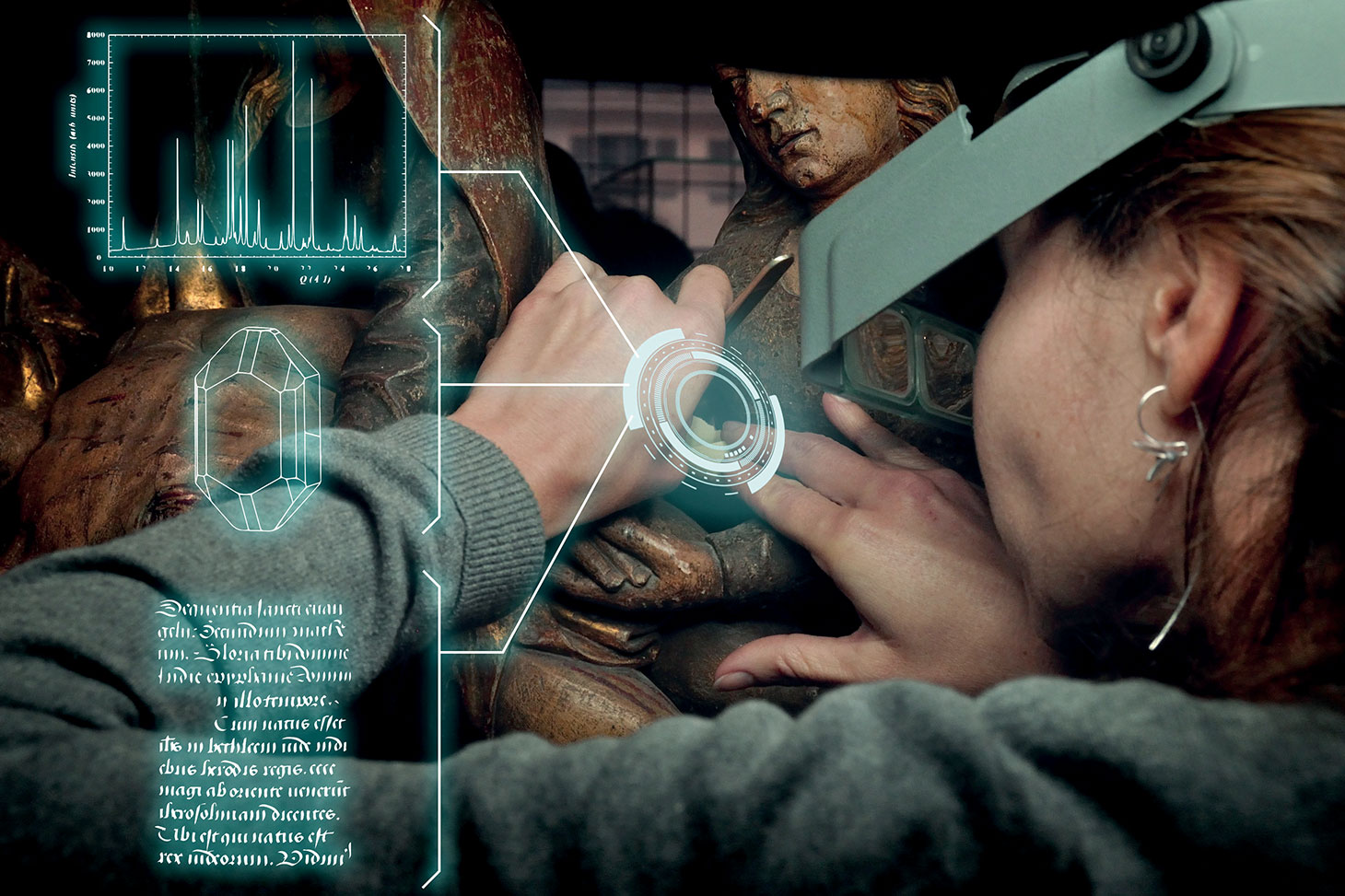
Patrimalp is conducting field-based experiments in collaboration among researchers from different fields—art history, the history of ideas, archaeology, materials science, and computer science—by addressing challenges related to a single object or concept—in this case, color—which involves shared activities, such as interdisciplinary co-supervision of dissertations, and the use of common tools —Mobififf, ESRF, digital ontology… The subject is studied from the perspective of each discipline and by all disciplines in a complementary manner.
A Transformative Project
Patrimalp is taking on the challenge of developing non-invasive, on-site (MobiDiff) and non-destructive (synchrotron imaging) methods for understanding cultural heritage objects. The project utilizes cutting-edge technologies, including AI, for processing big data. It collects crucial documentation (a pigment library of Neolithic Alpine coloring materials, stratigraphies of medieval polychromies, etc.). The interpretation of this contextualized data aims to write a renewed history of science and technology, made available to heritage professionals (curators, conservators) and the general public.
A national and international reach
Patrimalp is as much a part of—and a driving force behind—the recent scientific interest in the study of tangible heritage as it is a commitment to collaborating with both established and emerging organizations: nationally, such as the BnF, OSUG, FSP, OPUS Sorbonne University, and the CAI-RN network; and internationally, with the UNITA network—an alliance of six European universities—and E-Rhis.
To increase the visibility of the Grenoble site
The project is part of the current revitalization of heritage research and promotion at the national level. It is supported by existing, recognized networks. It is distinguished by a high concentration of top-tier research teams at a single site and by the support of two centers: ARC-Nucléart and the ESRF. Ultimately, it aims to make the Grenoble site a leader in research on the colored materials of ancient cultural artifacts.
Share the linkCopyCopiedClose the modal windowShare the URL of this pageI recommend this page:Available at this address:The page will then be accessible from your "My Favorites" menu.Stop the videoPlay the videoMutePlay audioChat: Have a question?Robo Fabrica ChatbotMatomo Traffic StatisticsX (formerly Twitter)