The multidisciplinary research project YEAH! (Youth Health from a Holistic Perspective) aims to study the health of young children and adolescents and their physical activity.
Topics:
Health.
Objectives
The goal of the YEAH! project is to develop an innovative, personalized program to improve the health of children (ages 8–10) and adolescents (ages 14–16) by influencing their behaviors (physical activity, screen time, diet, and sleep). To achieve this, the YEAH! program will train those around them (parents, teachers, etc.) to adopt a style of interaction that encourages children and adolescents to adopt healthy behaviors, using digital solutions. The program’s development is grounded in scientific knowledge while being co-created with end users and stakeholders to ensure it is tailored as closely as possible to the needs of children and adolescents.
Research Areas
The program will unfold in three phases. First, the behavioral intervention will be designed during the first and second years of the project, including the technical development of a mobile app that will serve as a platform for educating children, adolescents, and their social circles. The third year of the project will be devoted to implementation. The interventions will then be carried out in 7 countries with more than 2,688 children and adolescents (approximately 400 per country) in 8 schools to reach a socioeconomically diverse population.
"YEAH! This is a great opportunity to implement an initiative from start to finish—from design to evaluation—and to test it on a large scale. The ultimate goal is a nationwide rollout involving as many schools as possible to create a snowball effect." "I'm delighted," says Aïna Chalabaev, a professor at UGA and the project coordinator.
Collaborations
At the University ofUniversité Grenoble Alpes s (UGA), the project involves about 20 people across 8 research units:
The Translational Research and Innovation in Medicine and Complexity Laboratory (TIMC—CNRS / UGA—Grenoble INP—UGA / VetAgro Sup).
The Sport and Social Environment Laboratory (SENS - UGA).
Pacte, Social Sciences Laboratory (CNRS / UGA – Sciences Po – UGA).
The Grenoble Computer Science Laboratory (LIG - CNRS / Inria / UGA – Grenoble INP - UGA).
The Hypoxia and Cardiovascular and Respiratory Pathophysiology Laboratory (HP2 - Inserm / UGA).
The Grenoble Alpes Research Unit for High-Performance Computing and Data Infrastructure (GRICAD—CNRS / Inria / UGA – Grenoble INP – UGA).
The Grenoble Laboratory of Applied Economics (GAEL—CNRS / INRAE / UGA—Grenoble INP—UGA).
The Center for Applied Management Studies and Research (CERAG - UGA – Grenoble INP - UGA).
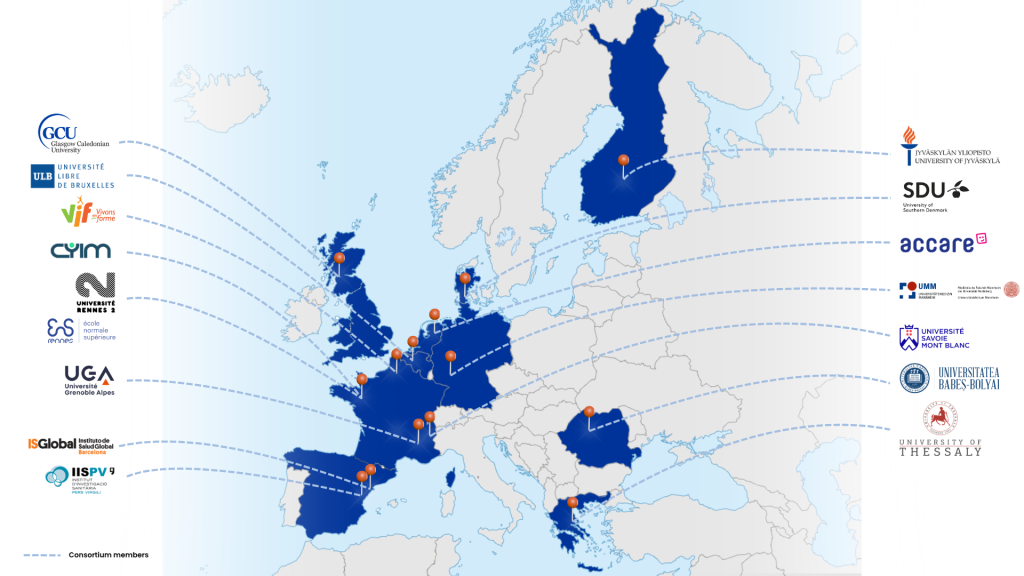
The YEAH! project brings together a multidisciplinary consortium of 16 organizations, including renowned universities, research institutes, hospitals, and associations from 10 countries.
The Project at a Glance
Truck Driver / Pilot
Université Grenoble Alpes
Partners / Consortium Members
Savoie Mont Blanc University
Babeș-Bolyai University
University of Southern Denmark
Barcelona Institute of Global Health Private Foundation
University of Thessaly
Glasgow Caledonian University
Ruprecht-Karls University of Heidelberg
Free University of Brussels
University of Jyväskylä
Fleurbaix Laventie Healthy City Association
École Normale Supérieure de Rennes
University and General Children's Foundation
Pere Virgili Institute for Health Research Foundation
University of Rennes II
CYIM (CYber IMagination)
Funding Sources
Horizon Europe
Coordinator
Aïna Chalabaev, professor at UGA in the Sport and Social Environment Laboratory (SENS - UGA)
This project was funded by the European Union’s Horizon Europe program under Grant Agreement No. 101155977.
The views and opinions expressed are, however, those of the authors and do not necessarily reflect those of the European Union or the European Executive Agency for Health and Digital. Neither the European Union nor the European Executive Agency for Health and Digital can be held responsible for them.
Updated on October 14, 2026
Horizon Europe
The European Union’s Framework Program for Research and Innovation
Horizon Europe, which follows the Horizon 2020 program that ended in late 2020, is the European Union’s new research and innovation program with a budget of approximately 95.5 billion euros for the 2021–2027 period—30% more than the previous program. This makes it the most ambitious research and innovation program in the world.
This framework program embodies the European Union’s commitment to distinguishing itself in a highly competitive international environment in order to raise the profile of cutting-edge research and innovation, attract top talent—particularly through competitive funding—and address current global challenges.
Share the linkCopyCopiedClose the modal windowShare the URL of this pageI recommend this page:Available at this address:The page will then be accessible from your "My Favorites" menu.Stop the videoPlay the videoMutePlay audioChat: Have a question?Robo Fabrica ChatbotMatomo Traffic StatisticsX (formerly Twitter)